E-commerce Strategy Fit Calculator
Answer these questions to determine the best initial sales channel for your product.
Your Recommendation:
Analyzing...| Factor | Independent E-commerce (DTC) | Amazon Marketplace |
|---|---|---|
| Best For | Building a brand, high-margin niche products, controlling data. | High-volume generic goods, quick cash flow, leveraging Prime trust. |
| Logistics | You control packing, carriers, and returns policy. | Amazon controls fulfillment (FBA) or strict guidelines (FBM). |
| Risk | Marketing costs can be high; slower initial traction. | Account suspension risk; fee increases; less brand equity. |
It’s a question that trips up new entrepreneurs and even seasoned marketers alike: "What is the difference between e-commerce and Amazon?" It sounds like comparing apples to oranges, but it’s more like comparing e-commerce (the entire fruit bowl) to Amazon Marketplace (a specific, massive grocery store within that bowl). If you are building an online business, understanding this distinction isn’t just semantic-it dictates your entire supply chain, marketing budget, and customer experience strategy.
Many people use the terms interchangeably because Amazon is the biggest player in the game. But here is the reality: E-commerce is a broad industry sector encompassing every transaction conducted online, from a local bakery selling cookies on Shopify to a multinational corporation selling software via SaaS platforms. Amazon, specifically, is a multi-national technology company focusing on e-commerce, cloud computing, digital streaming, and artificial intelligence. For our purposes, we are looking at Amazon as a sales channel or marketplace.
Defining the Entities: The Platform vs. The Channel
To get the logistics right, you have to define what you are actually operating. E-commerce is defined as the buying and selling of goods or services using the internet, and the transfer of money and data to execute these transactions. It is the umbrella term. You can run an e-commerce business through your own website (DTC or Direct-to-Consumer), through social media shops, or through marketplaces.
Amazon, on the other hand, is an American multinational technology company that serves as one of the largest online marketplaces where third-party sellers can list products alongside Amazon's own inventory. When you sell on Amazon, you are renting shelf space in their digital warehouse. You are subject to their algorithms, their fee structures, and increasingly, their logistics network known as Fulfillment by Amazon (FBA).
The confusion often stems from the fact that for many small businesses, "doing e-commerce" literally means "selling on Amazon." But if you rely solely on Amazon, you aren't owning your e-commerce infrastructure; you're leasing it. This has massive implications for how you handle returns, branding, and shipping speeds.
The Logistics Divide: Who Moves the Box?
This is where the rubber meets the road. In a traditional e-commerce model-say, you run a brand on Shopify-you control the logistics stack. You choose your courier (FedEx, UPS, Canada Post, DHL), you decide whether to pack orders in-house or hire a Third-Party Logistics provider (3PL), and you set your shipping rates.
On Amazon, particularly if you use Fulfillment by Amazon (FBA), a service where sellers send their products to Amazon's fulfillment centers, and Amazon handles storage, packing, shipping, and customer service, the logistics model shifts dramatically. You ship bulk inventory to Amazon. They store it. When a customer buys, Amazon picks, packs, and ships it. You lose control over the unboxing experience unless you pay extra for specialized packaging services, and you lose direct contact with the customer during the delivery phase.
| Feature | Independent E-commerce (DTC) | Amazon Marketplace (FBA/FBM) |
|---|---|---|
| Inventory Storage | Your Warehouse or 3PL | Amazon Fulfillment Centers |
| Shipping Control | High (Choose carrier/speed) | Low (Amazon Prime standard) |
| Customer Data | Full Ownership (Emails, behavior) | Limited (Anonymized mostly) |
| Return Handling | Customizable Policy | Strict Amazon Guidelines |
| Cost Structure | Fixed + Variable Shipping | Fees + Referral + FBA Fees |
Customer Ownership and Brand Equity
Why does this matter for logistics? Because logistics is part of the brand promise. When a customer receives a package from your independent site, they see your logo, your thank-you note, and perhaps a discount code for next time. That is owned media. You built a relationship.
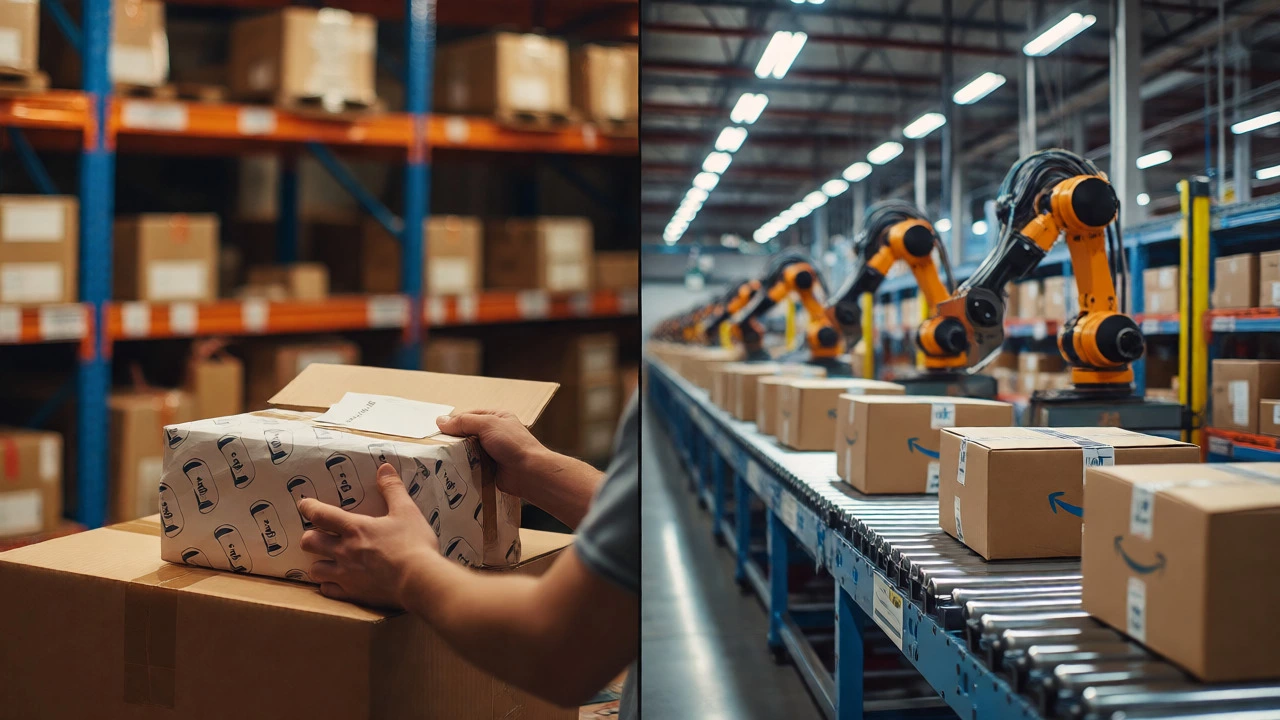
When a customer receives a box with the Amazon smile arrow, they think, "I bought this from Amazon," not necessarily "I bought this from [Your Brand]." Even if you spent thousands on branding, Amazon’s logistics layer acts as a buffer. You don’t get the email address of the buyer in many cases, making retargeting difficult. You are essentially paying Amazon for access to their traffic, and they take a cut of both the sale and the logistical convenience.
Consider the return process. On your own site, you might offer a 30-day return window with free prepaid labels to build trust. On Amazon, customers expect easy, often instant refunds. If your product has a high return rate due to sizing issues, Amazon’s strict policy might eat into margins faster than a flexible DTC policy would allow. You need to factor this "logistics friction" into your pricing.

Scalability and Risk Management
Selling on Amazon offers immediate scalability in terms of reach. You tap into hundreds of millions of active users without spending a dollar on Facebook ads initially. However, this comes with platform risk. Your account can be suspended due to policy violations, sometimes erroneously, halting your revenue overnight. Your logistics pipeline stops because you cannot access your inventory held in Amazon warehouses easily during disputes.
In contrast, independent e-commerce scales slower but builds asset value. You own the domain, the email list, and the customer history. If Instagram changes its algorithm or Amazon changes its fees, your independent store remains stable. From a logistics perspective, diversifying is key. Many successful brands use a hybrid model: they launch on Amazon to generate cash flow and reviews, then drive traffic to their own website for repeat purchases, keeping the higher-margin, loyal customers under their own logistical roof.
Which Model Fits Your Business?
If you are just starting out with limited capital, Amazon removes the headache of finding a warehouse and negotiating courier contracts. It’s turnkey. But if you are building a long-term brand with unique products, relying solely on Amazon turns you into a commodity seller competing on price and Prime shipping speed rather than brand story.
Think about your product type. Are you selling generic phone cases? Amazon wins on volume and speed. Are you selling custom-made jewelry or niche supplements? An independent e-commerce site allows you to explain the value proposition, bundle products, and control the shipping timeline to ensure quality control before dispatch.
Ultimately, the difference isn't just technical; it's strategic. E-commerce is the vehicle; Amazon is a highway. You can drive fast on the highway, but you don't own the road, and you can't stop wherever you want to look at the scenery.
Is Amazon considered an e-commerce platform?
Yes, Amazon is a major e-commerce platform. Specifically, it operates as an online marketplace where both first-party sellers (Amazon itself) and third-party sellers list products. While e-commerce refers to the general activity of buying and selling online, Amazon is a specific service facilitating those transactions.
Can I sell my own website products on Amazon?
Absolutely. Most brands use a multichannel strategy. You can list your products on Amazon to capture search-driven traffic while maintaining your own website for brand loyalty and higher profit margins. Just be aware of pricing consistency requirements and potential conflicts with Amazon's own private label brands.
What is the main logistical difference between FBA and self-shipping?
With Fulfillment by Amazon (FBA), you send inventory to Amazon's warehouses, and they handle picking, packing, and shipping. With self-shipping (Fulfilled by Merchant), you store inventory yourself (or at a 3PL) and arrange shipping directly to the customer when an order is placed. FBA offers Prime eligibility automatically; self-shipping requires you to meet Prime standards independently.
Do I own my customer data on Amazon?
Generally, no. Amazon protects customer privacy by masking email addresses and personal details. Sellers receive anonymized order data. On an independent e-commerce site, you collect full customer profiles, allowing for direct marketing, newsletters, and personalized follow-ups, which are crucial for retention.
Which is cheaper: Selling on Amazon or running my own site?
It depends on volume and marketing costs. Amazon charges referral fees (typically 8-15%) and FBA fees per unit. Running your own site involves hosting costs, payment processing fees (approx. 2.9% + $0.30), and significant advertising spend to acquire customers. Amazon provides traffic for a fee; your own site requires you to buy traffic or earn it organically.