International Shipping Cost-Efficiency Calculator
Find the best balance between speed, volume, and risk. Enter your shipment details to see which mode (Sea, Air, Rail, or Courier) offers the best value.
| Mode | Est. Cost | Transit | Suitability |
|---|
Why this choice?
Enter shipment details to calculate the most efficient shipping method.
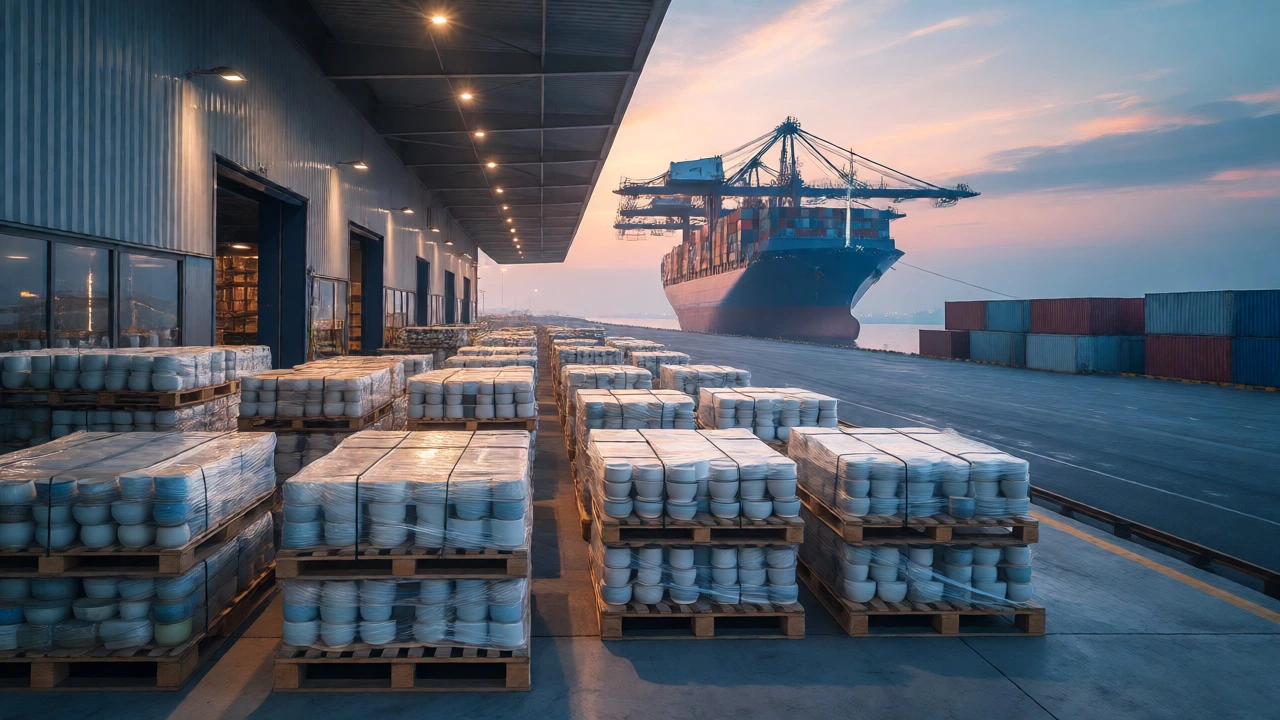
You just landed a big order from a client in Germany. You're excited until you get the quote for shipping your pallets of handmade ceramics. It's $2,400. That number might eat your entire profit margin if you don't know how to structure the logistics. Here is the truth: there is no single "cheapest" way to ship internationally. The most cost-efficient method depends entirely on what you are shipping, where it is going, and how fast you need it there.
As someone who has moved everything from microchips to furniture across borders, I can tell you that the cheapest option on paper often becomes the most expensive in reality due to hidden fees, delays, or damage. To find true efficiency, you have to balance speed, volume, and risk. This guide breaks down exactly how to calculate that balance so you stop overpaying for international shipping.
The Core Equation: Time vs. Volume vs. Value
Before you look at any carrier rates, you need to understand the three levers that control your costs. If you ignore one, you will likely lose money.
First is Volume. Carriers charge based on either actual weight or dimensional (volumetric) weight, whichever is higher. If you are shipping lightweight but bulky items like pillows, you pay for the space they take up, not their heaviness. Second is Time sensitivity. Air freight is fast but expensive. Sea freight is slow but cheap per unit. Third is Value density. High-value items like jewelry justify faster, more secure transport because the cost of delay or theft outweighs the shipping fee. Low-value, high-volume items like gravel or bulk textiles require the slowest, cheapest methods to remain profitable.
Your goal is to match these three factors with the right mode of transport. Mismatch them, and you bleed cash.
Sea Freight: The King of Cost Efficiency for Bulk
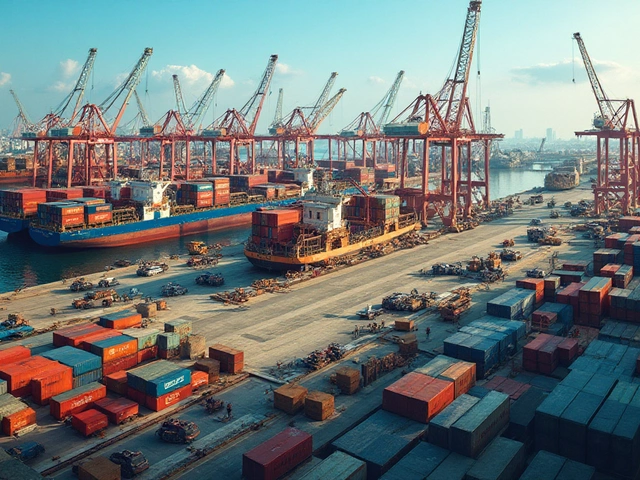
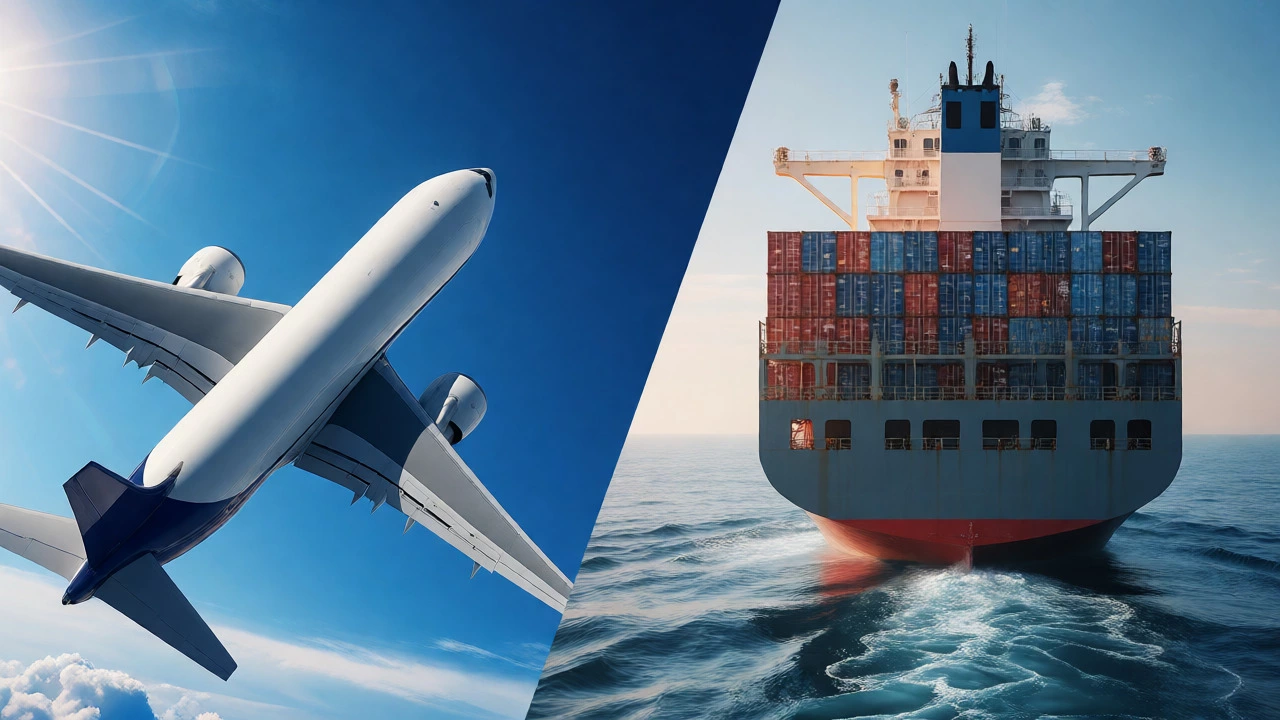
If you are moving large quantities of goods and time is not critical, Sea Freight is almost always the winner. It is the backbone of global trade, handling about 90% of all world trade by volume. Why? Because container ships move massive amounts of cargo at incredibly low costs per unit.
But here is where people get tripped up. There are two ways to book sea freight, and choosing the wrong one destroys your savings:
- FCL (Full Container Load): You rent an entire container (usually 20ft or 40ft). You pay a flat rate regardless of how full it is. This is efficient if you have enough goods to fill at least 70-80% of a container. You also get exclusive use, which reduces damage risk and speeds up customs clearance since your box isn't mixed with others.
- LCL (Less than Container Load): You share a container with other shippers. You pay only for the cubic meters (CBM) you use. This looks cheaper upfront for small shipments, but the per-unit cost is significantly higher than FCL. Plus, your goods spend extra time in warehouses being consolidated and deconsolidated, adding days to transit time.
Pro Tip: If you are close to filling a 20ft container, compare the LCL quote against an FCL quote. Often, renting a whole container costs less than paying LCL rates for 15+ CBMs because LCL includes steep handling fees at both origin and destination ports.
Air Freight: When Speed Saves Money
Air Freight costs 4 to 6 times more than sea freight per kilogram. So why would anyone use it? Because speed impacts inventory holding costs.
Imagine you sell trendy fashion items. If you ship via sea, you wait 30-45 days. By the time your stock arrives, the trend might be over, forcing you to discount heavily. Or consider perishable goods like fresh flowers or electronics with short product lifecycles. In these cases, the higher shipping cost is offset by selling at full price and avoiding obsolescence.
Air freight is also ideal for emergency restocks. If you run out of stock, every day you are empty is lost revenue. Paying $5/kg extra to fly in new inventory might save you $5,000 in lost sales. Always calculate the "cost of delay" before ruling out air freight.
Courier Services: Best for Small Parcels, Not Pallets
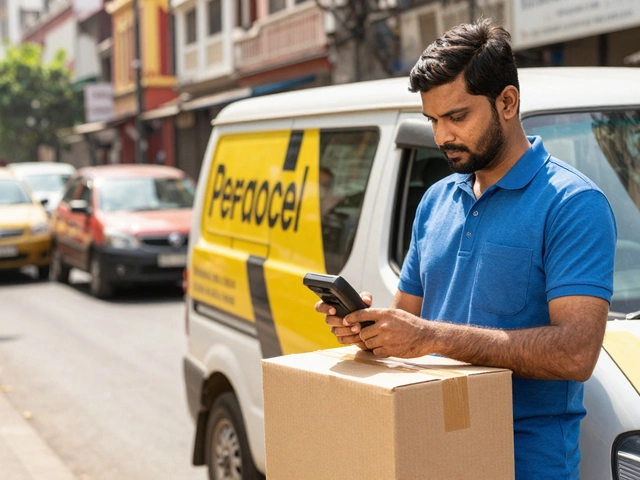
Companies like DHL, FedEx, and UPS offer door-to-door convenience with tracking and insurance included. They are fantastic for B2C e-commerce orders under 30 kg. Their network is optimized for last-mile delivery, meaning they handle customs clearance and local delivery seamlessly.
However, for B2B shipments or anything heavier than a few boxes, courier services become prohibitively expensive. They charge premium rates for the convenience of guaranteed timelines and integrated logistics. If you are shipping a pallet of samples, a courier might charge $800. A freight forwarder arranging air freight for the same pallet might charge $300 plus separate customs fees, totaling $450. For heavy goods, avoid couriers unless you value simplicity over cost.
Rail Freight: The Underrated Middle Ground
For shipments between Europe and Asia, Rail Freight offers a compelling alternative. It is slower than air (taking 15-20 days via the China-Europe rail corridor) but much faster than sea (which takes 30-45 days). Costs sit roughly halfway between air and sea.
This mode is particularly useful for mid-value goods that need better reliability than sea but cannot justify air prices. Electronics, automotive parts, and machinery often travel this route. Note that rail infrastructure is limited to specific corridors, so check if your origin and destination cities have direct rail links before considering this option.
| Mode | Relative Cost | Transit Time (Asia to US/EU) | Best For |
|---|---|---|---|
| Sea (FCL) | $ (Lowest) | 25-45 Days | Bulk, non-perishables, high volume |
| Sea (LCL) | $$ (Medium-Low) | 30-50 Days | Small volumes (<15 CBM), flexible timing |
| Rail | $$$ (Medium) | 15-20 Days | Europe-Asia corridor, mid-value goods |
| Air Freight | $$$$ (High) | 3-7 Days | High-value, urgent, perishable |
| Courier | $$$$$ (Highest) | 2-5 Days | Small parcels (<30kg), B2C orders |

The Hidden Cost Killer: Incoterms and Customs
You can pick the cheapest carrier, but if you choose the wrong Incoterms (International Commercial Terms), you will face surprise bills. These terms define who pays for shipping, insurance, and duties at each stage.
The most common mistake is using EXW (Ex Works). With EXW, the buyer picks up goods from the seller's factory. This sounds cheap for the seller, but the buyer now has to arrange inland transport, export customs, and ocean freight. Buyers often lack local knowledge, leading to inefficient routing and higher costs. They then negotiate lower prices from you, eating into your margins.
Instead, try FOB (Free on Board) or CIF (Cost, Insurance, and Freight). Under FOB, you handle costs up to the port of departure. The buyer handles the rest. This gives you control over the initial leg while letting the buyer manage their preferred carrier for the main journey. For maximum control and potential savings through consolidation, many experienced exporters prefer DDP (Delivered Duty Paid), where you handle everything. This allows you to bundle shipping costs into the product price, creating a seamless experience for the buyer, though you must accurately predict duty rates to avoid losses.
Strategies to Cut Costs Without Cutting Corners
Once you have chosen your mode, here are practical tactics to shave off more percentage points:
- Pack Smart: Dimensional weight kills budgets. Use custom-sized boxes instead of standard ones to eliminate dead space. If you ship 10% less air, you pay 10% less freight.
- Consolidate Shipments: Instead of sending weekly small packages, accumulate goods and send monthly larger shipments. This moves you from courier rates to freight rates.
- Negotiate Spot Rates: Do not rely solely on contract rates. If market capacity is high (lots of empty ships/planes), spot rates drop. Ask your forwarder for spot quotes regularly.
- Check HS Codes: Duties are based on Harmonized System codes. Sometimes, slightly altering a product description or component classification can shift it to a lower-duty category. Verify this with a customs broker.
- Use a Freight Forwarder: Unlike carriers, forwarders do not own planes or ships. They buy space in bulk and resell it. They often have access to negotiated rates that individual businesses cannot get alone. They also handle paperwork errors that cause costly delays.
Final Thoughts: It's About Total Landed Cost
Stop looking at the shipping invoice in isolation. Calculate your Total Landed Cost. This includes the product cost, shipping, insurance, duties, taxes, port fees, and inland transportation. Only then can you see which method is truly efficient.
For most businesses, the sweet spot is consolidating smaller shipments into LCL or FCL sea freight whenever possible, using air only for emergencies, and leveraging a good freight forwarder to navigate the complex web of customs and documentation. Start by analyzing your last year's shipping data. Identify which products were shipped via air unnecessarily. Switch them to sea. Watch your margins improve.
Is sea freight always cheaper than air freight?
Generally, yes, sea freight is significantly cheaper per unit for large volumes. However, for very small, high-value, or urgent shipments, the overhead costs of sea freight (customs brokerage, port handling, warehousing) can make air freight competitive or even cheaper when factoring in reduced inventory holding costs.
What is the difference between LCL and FCL?
LCL (Less than Container Load) means you share a container with other shippers and pay for the space you occupy. FCL (Full Container Load) means you rent the entire container exclusively. FCL is usually more cost-effective for larger volumes (typically over 15 CBM) and offers better security and faster transit times since your goods aren't delayed by consolidation processes.
How do Incoterms affect my shipping costs?
Incoterms define who is responsible for costs and risks at each stage of transport. Choosing terms like EXW shifts most responsibilities to the buyer, potentially lowering your direct shipping costs but possibly reducing your competitiveness. Terms like DDP place all costs on you, allowing for better control and bundling, but require accurate forecasting of duties and taxes to maintain profitability.
Can I negotiate rates with international carriers?
Yes, especially if you have consistent shipping volumes. While spot rates fluctuate, negotiating annual contracts with carriers or freight forwarders can lock in favorable pricing. Additionally, asking for spot rates during periods of low demand can yield significant discounts compared to standard published tariffs.
What are dimensional weights and why do they matter?
Dimensional (or volumetric) weight calculates the cost based on the space a package occupies rather than its actual physical weight. Carriers use this because light but bulky items take up valuable cargo space. If your package's dimensional weight is higher than its actual weight, you are charged based on the dimensional weight, making efficient packing crucial for cost savings.